
All event times listed are Eastern Standard Time zone (EST: New York) unless otherwise noted in the event title and description. A time zone converter is available here.

- This event has passed.
Corporate Entrepreneurship in Circular Economy
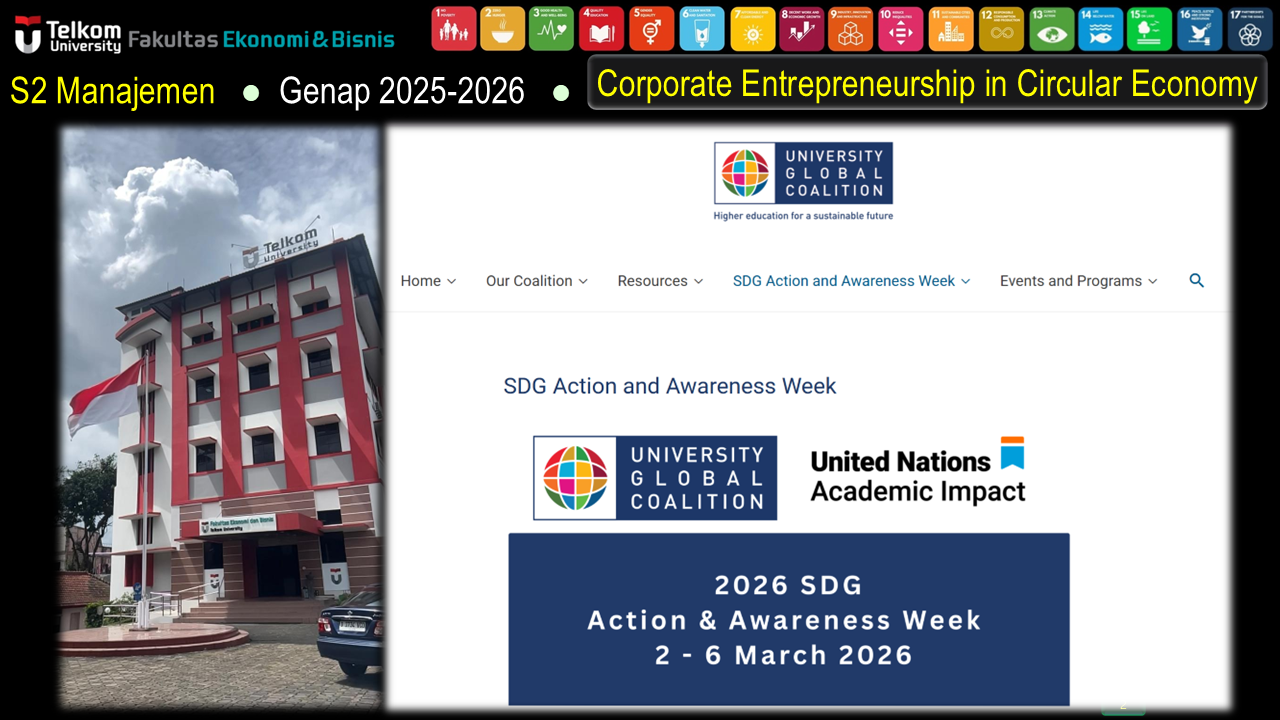
Event Description:
Online Class Discussion – Master in Management, Telkom University
This online class discussion invites Master in Management students of Telkom University to critically explore the role of corporate entrepreneurship in advancing the circular economy, grounded in the Indonesian ecological context.
The session is centered on the newly published book Bacaan Bumi: Pemikiran Ekologis untuk Indonesia, which offers deep reflections on ecological crises, human–nature relationships, and alternative ways of thinking about development in Indonesia. Through this discussion, students will examine how ecological values and systems thinking can inform strategic innovation, intrapreneurship, and sustainable value creation within corporations.
Meeting link here: https://telkomuniversity-ac-id.zoom.us/j/93999069085
Presenters:
The discussion will be guided and facilitated by Ratna Lindawati Lubis https://www.sdgcompactfellows.org/ratna-lindawati-lubis, in her role as Senior Faculty for the course Corporate Entrepreneurship in Circular Economy at Telkom University. This session forms part of the ongoing even (genap) academic semester 2025–2026.
The participants are students from the Master in Management (MM) Reguler-32 class, consisting of 17 students, who are currently undertaking the course as part of their graduate curriculum. As the course instructor, she will guide the discussion by connecting theoretical perspectives from the newly published book Bacaan Bumi: Pemikiran Ekologis untuk Indonesia with strategic, entrepreneurial, and circular economy concepts relevant to corporate practice.
Language: Bahasa Indonesia
SDGs Addressed:
- It aligns with the United Nations SDGs:
• SDG 8 (Decent Work and Economic Growth): Promoting fair labor practices and sustainable economic growth.
• SDG 11 (Sustainable Cities and Communities): Designing business models that promote resource efficiency, waste reduction, and regenerative urban solutions.
• SDG 17 (Partnerships for the Goals): Fostering collaboration among businesses, governments, and civil society.
5 “P’s” of sustainable development (People, Planet, Prosperity, Peace, Partnership)
- People
- Planet
- Partnership